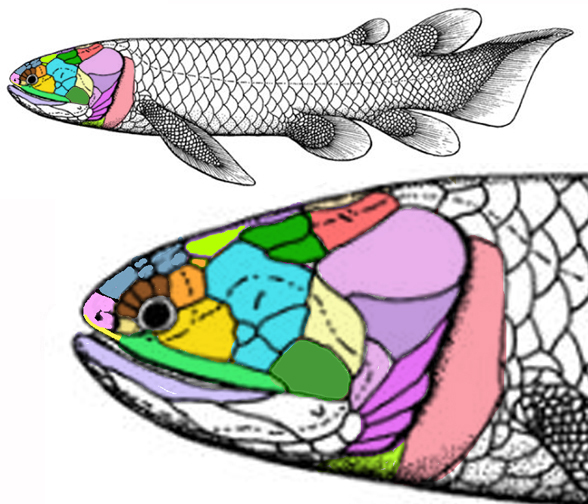
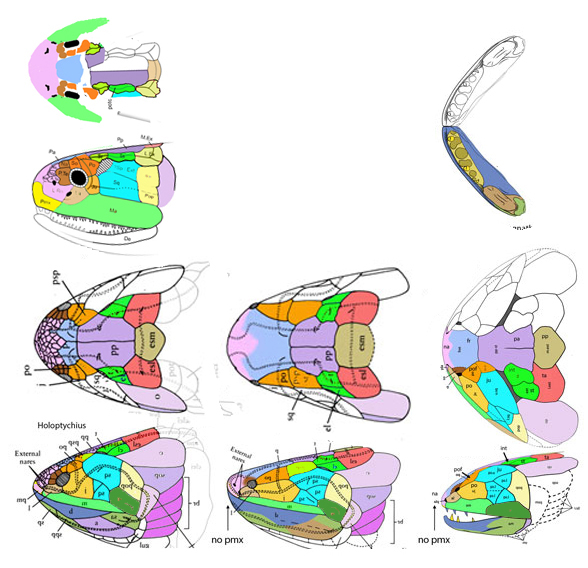
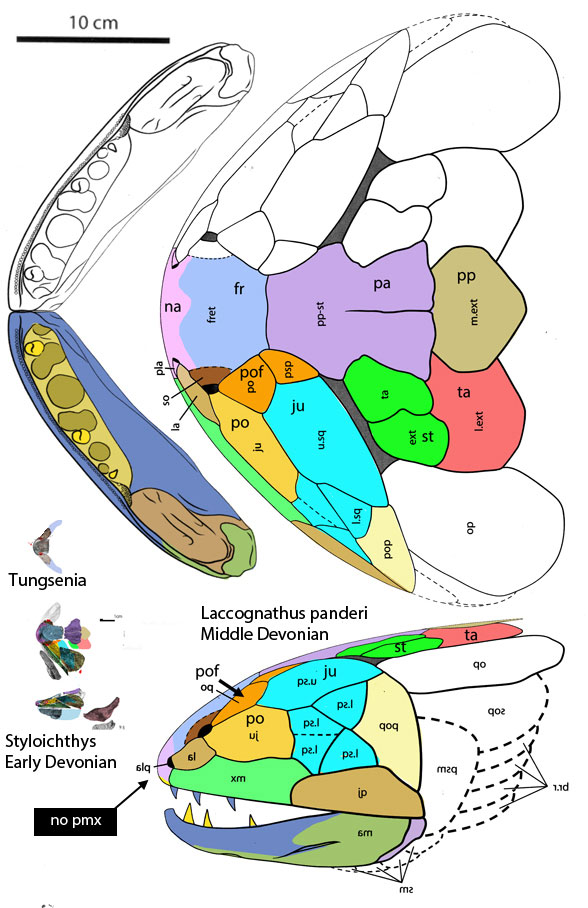
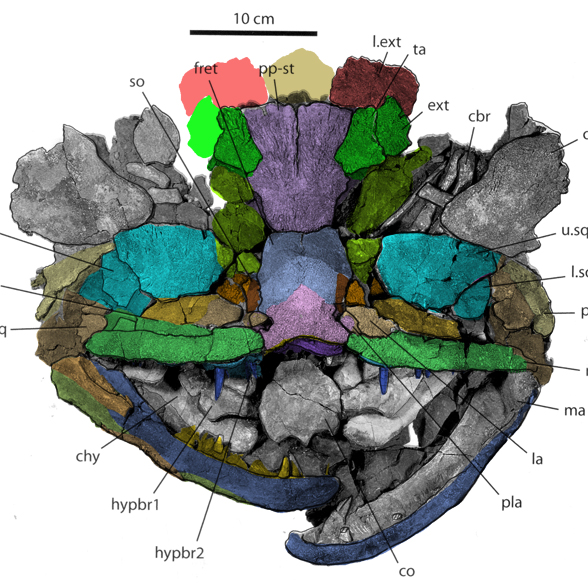
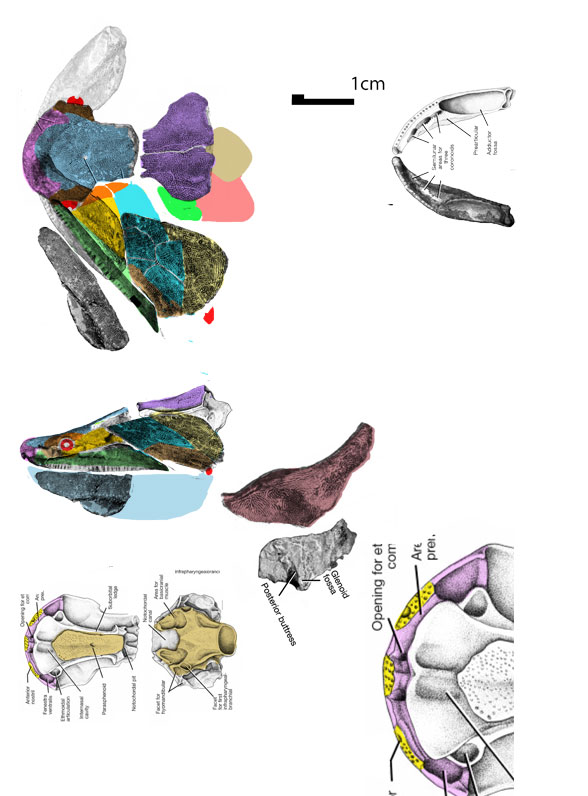
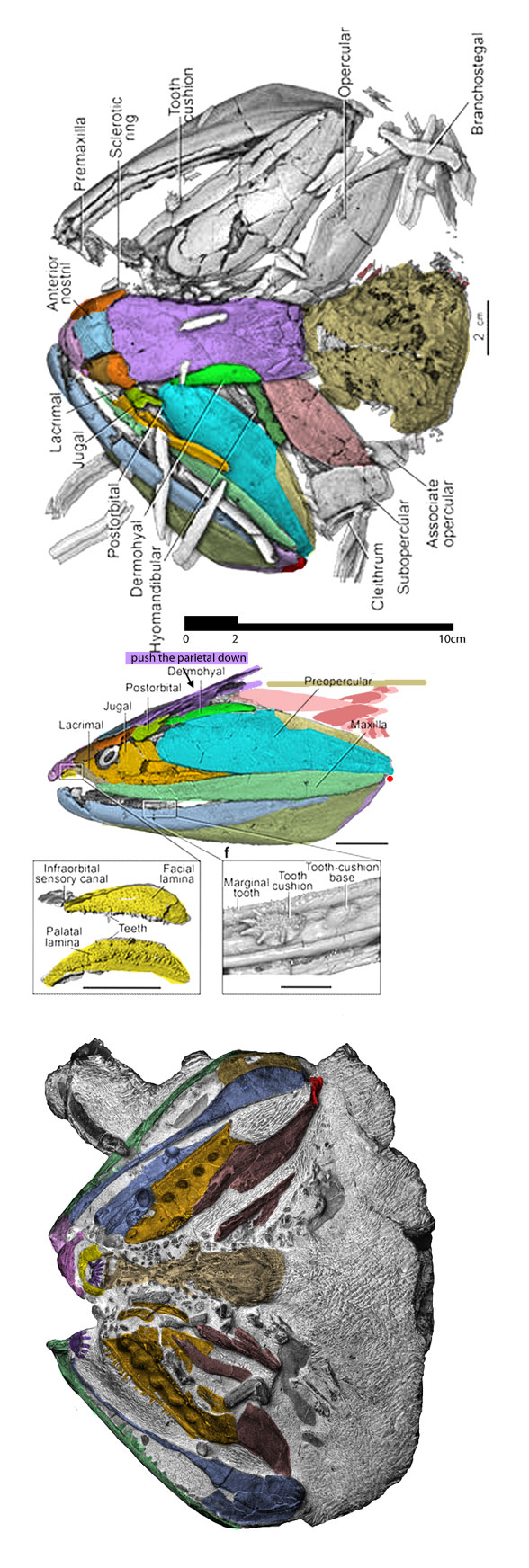
Megamastax amblyodus (Choo et al 2014, Lu et al 2026, Late Silurian, China) was the largest vertebrate predator of the Silurian and a sister to much smaller Early Devonian Styloichthys in the LRT. These are members of the Early Devonian Porolepiformes. Thus this taxon indicates an earlier Silurian radiation of this wide-jaw clade, nesting just prior to the split between lobe-fin pre-tetrapods and lungfish.
According to Wikipedia, "Megamastax can be safely considered a sarcopterygian (lobe-finned fish) due to having cosmine on its jaws, coronoid plates, a prearticular bone, and a biconcave glenoid, it is unique among early jawed fish for its jaw and teeth structure."
According to Lu et al 2026, "Megamastax—previously interpreted as a lobe-finned fish —exhibits distinct osteichthyan traits in the dermatocranium, such as resorptive tooth shedding and the presence of extrascapular bones. However, the arrangement of its dorsal aortae is reminiscent of crown-group chondrichthyans. The premaxilla with extensive palatal lamina and the elongated post-hypophyseal region of the braincase recall the condition in maxillate placoderms."
"Phylogenetic analysis places Megamastax within the osteichthyan stem, near the osteichthyan crown-group node, and provides a framework for exploring the sequence of character acquisition along the osteichthyan stem."
Megamastax has two rows of small marginal teeth. In addition, Megamastax uniquely has a row of large, blunt teeth fused to four coronoid bones on the inside edge of each mandible. |