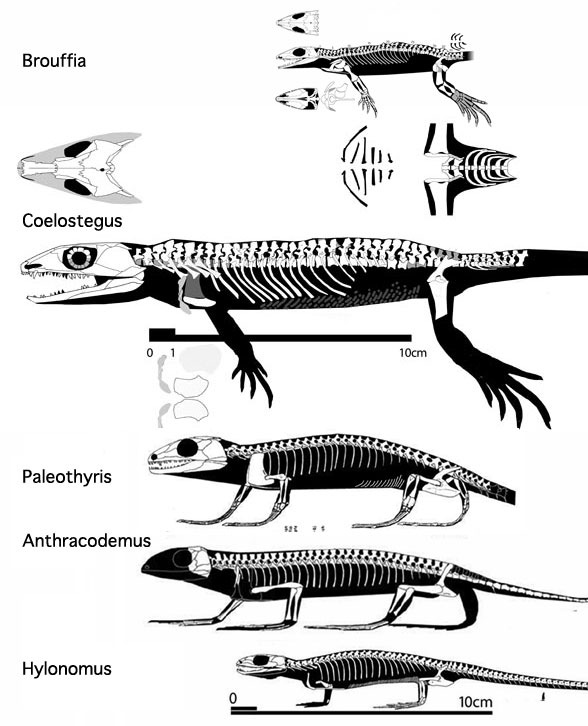
Paleothyris acadiana (Carroll 1969; Late Carboniferous, 310 mya) was derived from a sister to Coelostegus. Paleothyris phylogenetically preceded Hylonomus. The complete tree is here.
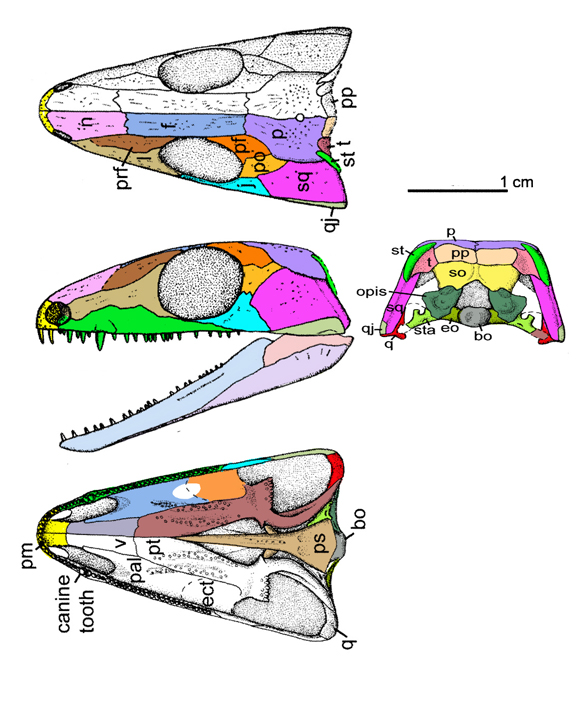
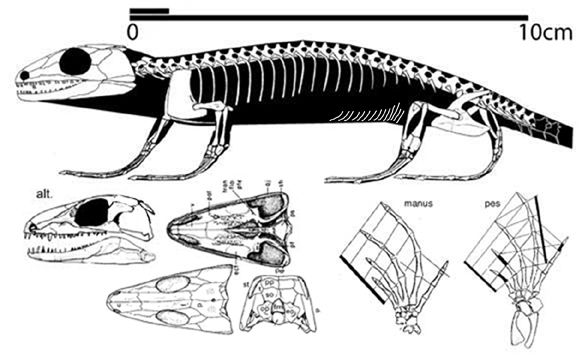
Distinct from Coelostegus, the skull of Paleothyris had a longer rostrum and shorter postorbital portion. The orbit was shorter than the rostrum. The lacrimal was not deeper than the maxilla. The postparietals were angled toward the occiput. The pterygoid teeth formed a single row along the transverse process. The frontal/nasal suture was a zig-zag. If the back of the skull had a downslope, then Paleothyris was likely using it canine tooth and high coronoid process to bite into animals too large to swallow whole in order to tear off chunks. The maxilla was slightly convex ventrally. The back of the mandible rose to a high coronoid process.
Distinct from Casineria, the vertebrae were each longer, especially anteriorly. The axis was enlarged. Only 27 presacral vertebrae were present. The dorsal ribs were more slender.
The scapulocoracoid was fused and well ossified with the scapula ascending higher than the clavicle. The cleithrum was absent. Manual phalanx 4.4 was longer than m4.3. Metacarpal I aligned with II and III and metatarsal I aligned with II and III.
The ilium was nearly identical to that in Westlothiana. The pubis and ischium were deeper. The hind limbs were longer as were the digits, which were similar in length to those in the manus.
Longer, more slender fingers and toes provided more agility and clinging power to clamber over branches and rocks. More slender limbs suggests more speed. |