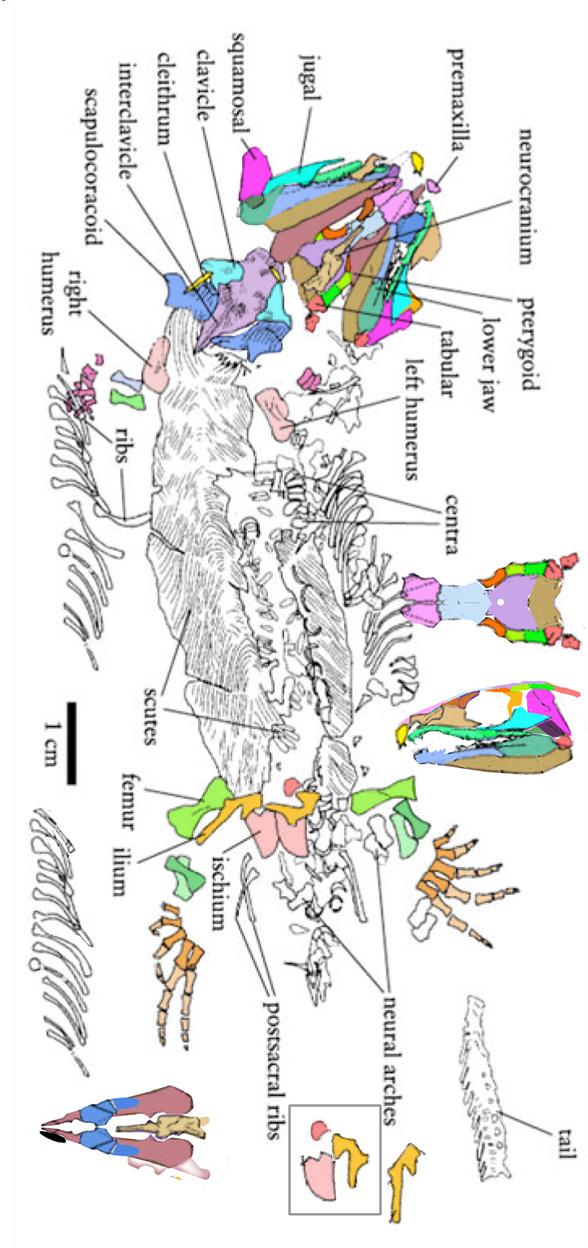
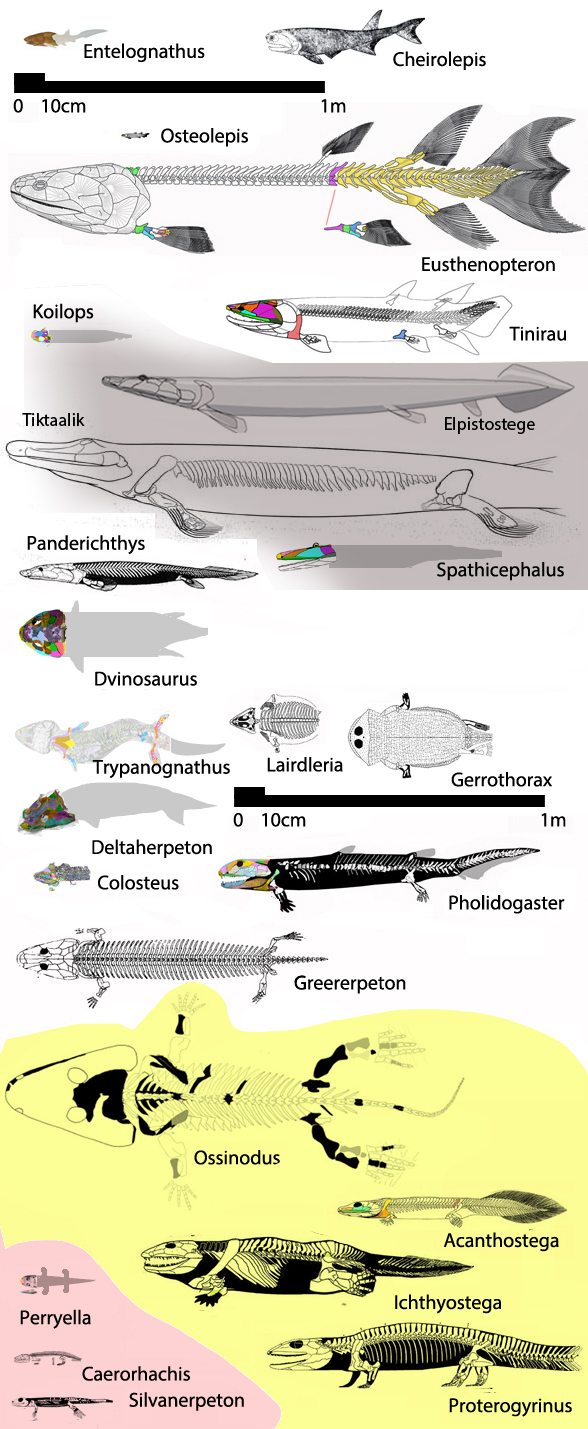
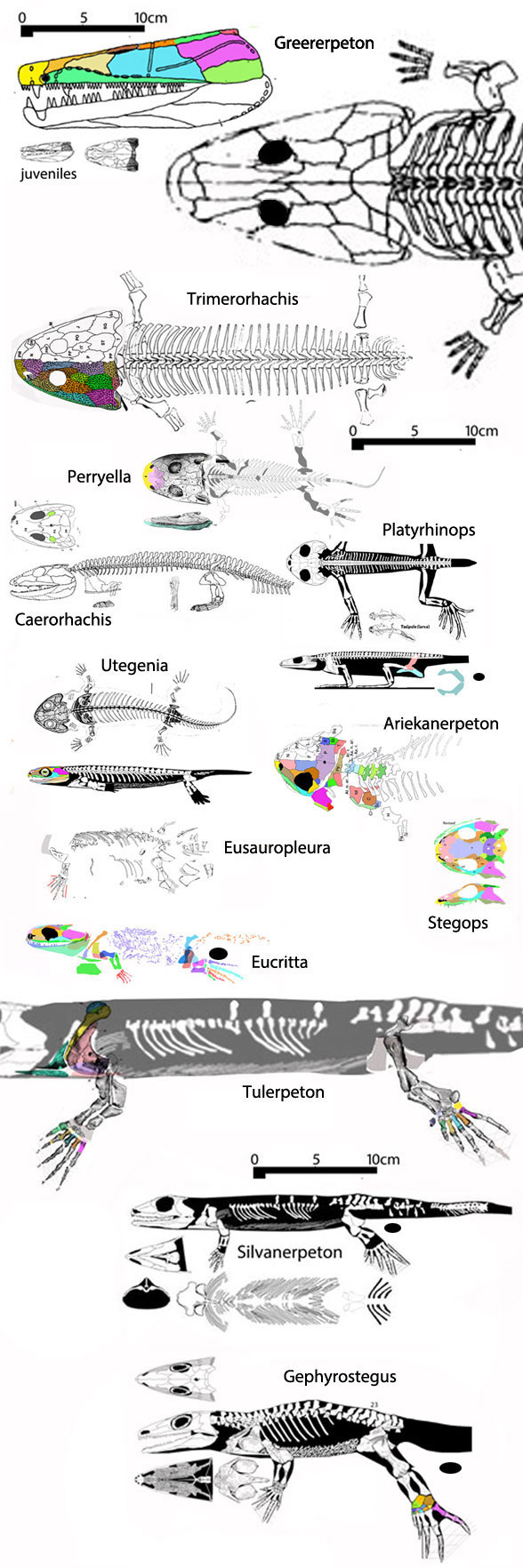
Silvanerpeton miripedes (Clack 1994) Visean, Early Carboniferous ~335 mya, ~40 cm in length, is the earliest known member of the Amniota, the last common ancestor of the Amniota/Reptilia. It was derived from a earlier sister to Gephyrostegus,
Distinct from Gephyrostegus, the skull of Silvanerpeton was short and dominated by the orbit (eye socket) which was a third of the skull length. The lacrimal contacted the jugal beneath the orbit, not anterior to it. The nares were larger than in more primitive taxa, such as Eoherpeton, and closer together. They faced anteriorly, as in Seymouria. The postorbital was triangular and it met a slender postorbital process of the jugal, as in reptiles. Long slender tabular "horns" jutted from the rear of the skull. The maxilla had 42 shorter, sharper teeth. The ectopterygoid was not a small sliver of bone, but a large disc that solidified the palate, as in Proterogyrinus and Gephyrostegus.
More
than 30 presacral vertebrae were present. The pleurocentra formed
almost complete hoops and the intercentra were smaller and wedge-shaped. The postsacral ribs were long. The tail was not laterally flattened, long or deep.
The interclavicle was
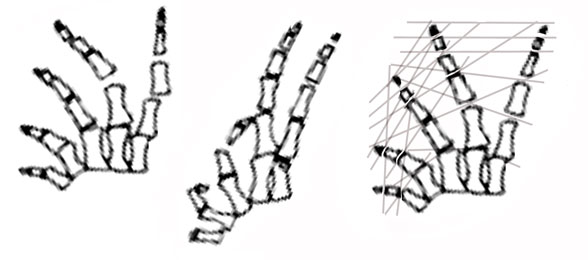
kite-shaped with a broad separation between the clavicles. The cleithrum was very slender. The manus was preserved as a jumble. Tiny claws first appear.
The ilium had a long posterior process and a very short dorsal process. The ischium was extended posteriorly. The femur was relatively large, ~37% of the skull length The pedal phalangeal formula was 2-3-4-5-5. The pes was preserved as a jumble. Tiny claws first appear. Pedal digit 1 was tiny. The toes were more asymmetrical in length (see below). |