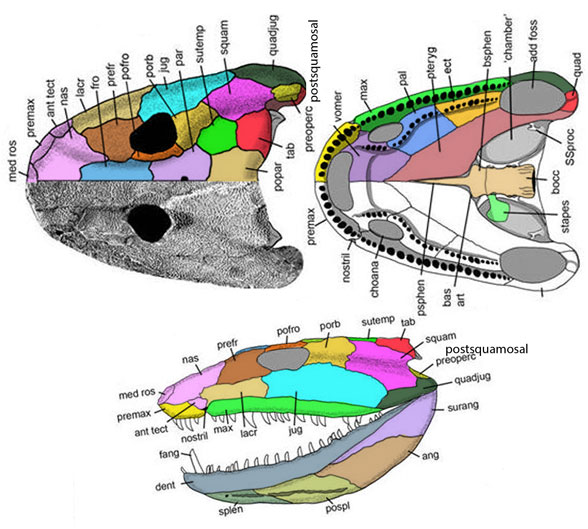
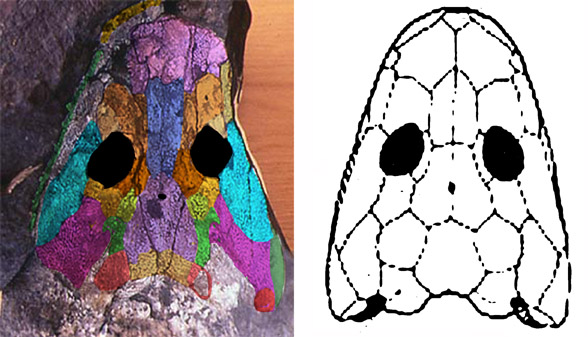
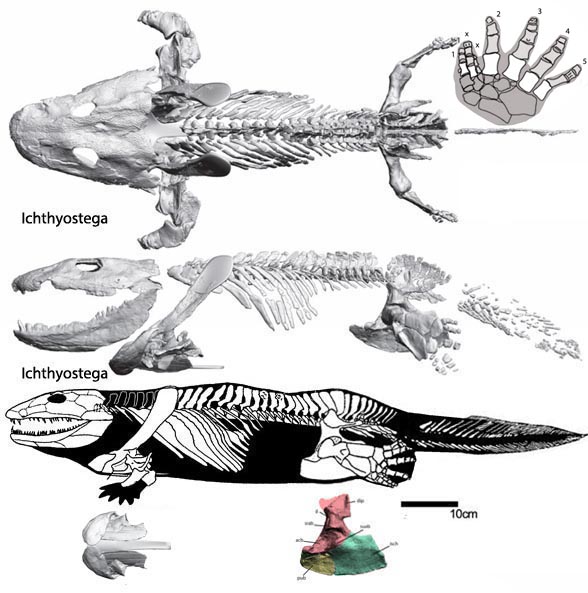
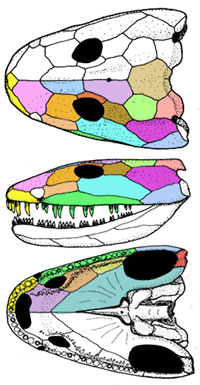
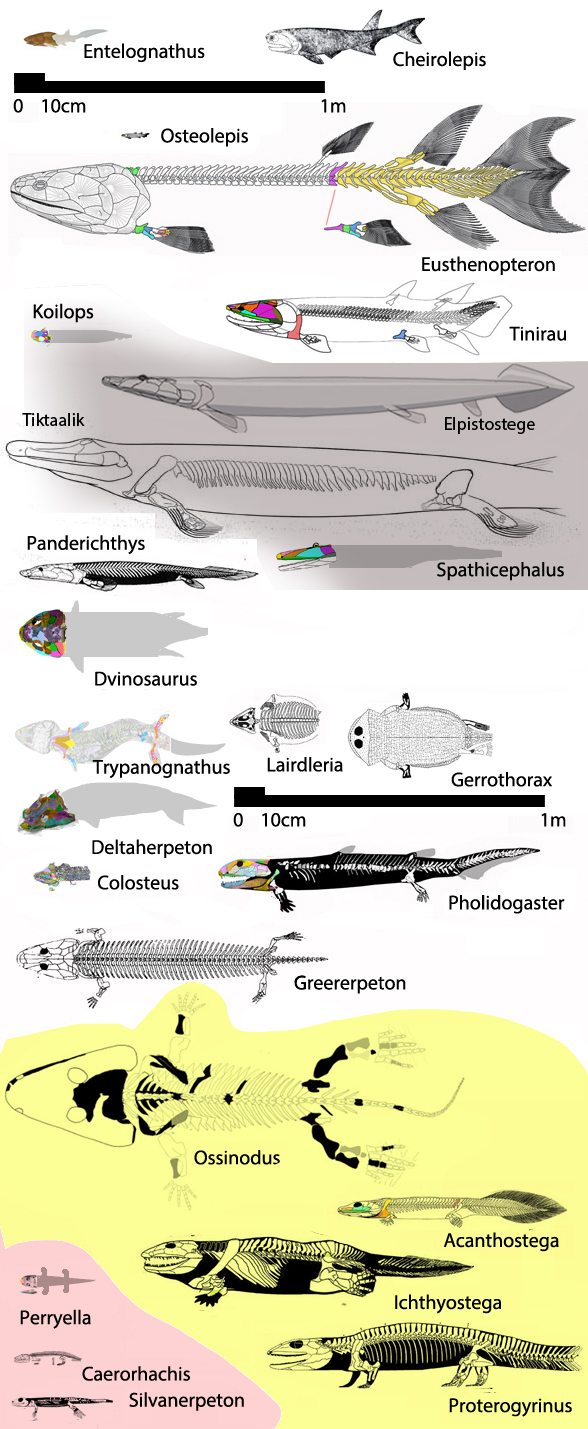
Ichthyostega stensioei (Säve-Söderbergh 1932; Late Devonian ~365 mya) The transition from fins to limbs continues with this taxon derived from Tiktaalik. and Acanthostega. Proterogyrinus and Pederpes are more derived sister taxa.
The nares (nostrils) opened low, close to the jaw lin. The marginal teeth were larger than the palatal fangs.
The vertebral column consisted of ~28 vertebrae, each composed of two parts. The lower intercentra wrapped around the notochord. The upper pleurocentra included a robust neural spine. The lepidotrichia is reduced. The dorsal ribs were longer and overlapped more.
The pectoral girdle was largely coossifled. The cleithrum was the largest element. The humerus was L-shaped. The radius was much longer than the ulna, proportions otherwise seen only in more primitive taxa.
The pelvis was largely coossified and relatively much larger. The ilium had a dorsal and posterior process. The femur was hourglass-shaped. The knee and ankle were not suitable for much bending. Six toes appear here. |