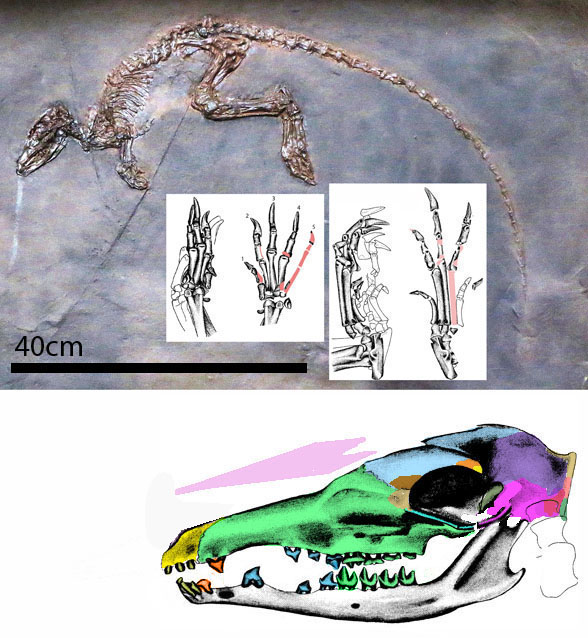
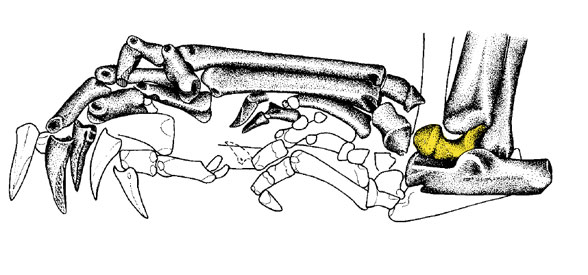
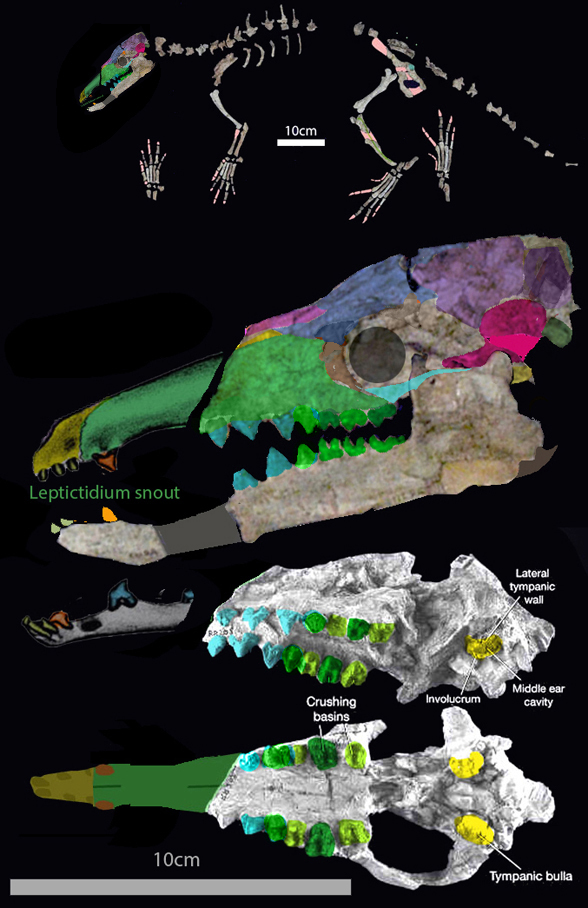
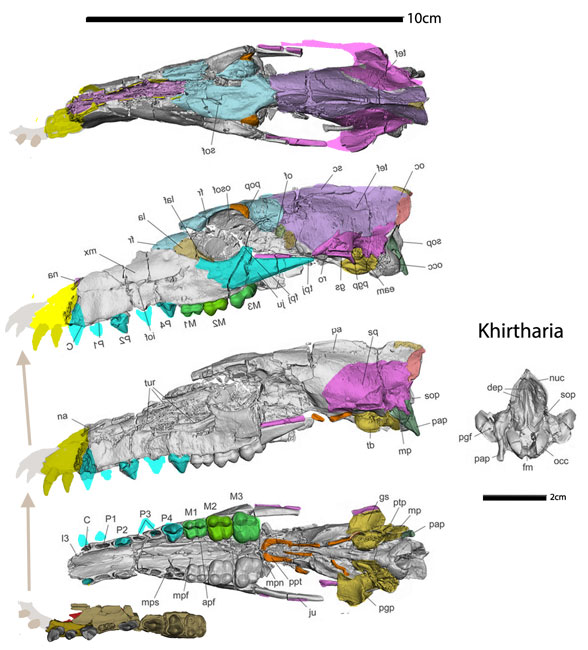
Khirtharia dayi , Khirtharia inflata (Pilgrim 1940, Waqas et al 2024; Orliac et al 2024; Middle Eocene, NW India) was originally and traditionally considered a basal artiodactyl close to Indohyus. These studies omitted sengis and tenrecs. The LRT nested these taxa with sengis and tenrecs.
Indohyus and Khirtharia are considered, "Raoellids – small, semiaquatic ungulates closely related to cetaceans." In the LRT neither nests close to any traditional ungulate. 'Cetacea' is not a monophyletic clade, so is invalid after analysis. Raoella was synonymized with Indohyus by Kumar and Sahni (1985), which was reaffirmed by Thewissen, Gingerich, and Russel (1987). Raoellids were generally diminutive creatures that were primarily herbivorous. They were thought to be basal artiodactyls with moderately long snouts that were distinguished from other mammals primarily by bunolophodont molars and other dental features. It was also noted that the raoellids appeared similar to the perissodactyls of the same region. The teeth contain a large basin and are specialized for shearing." Clade genera are largely dental taxa.
Khirtharia major, at about twice the size of an average-sized raoellid, would have been approximately the size of a coyote. |