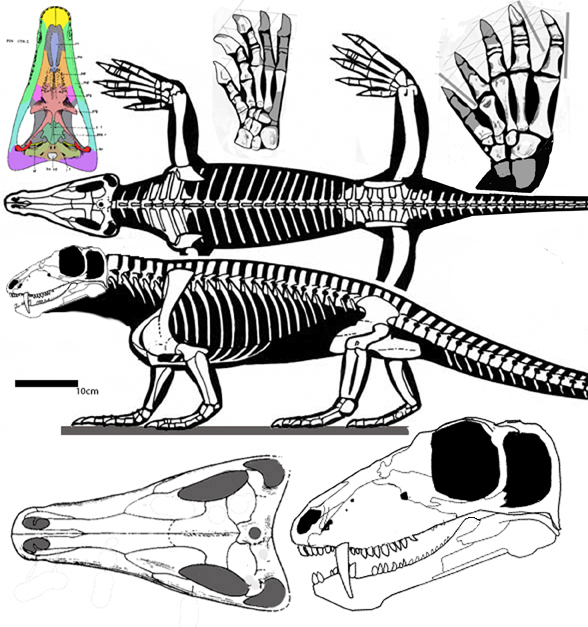
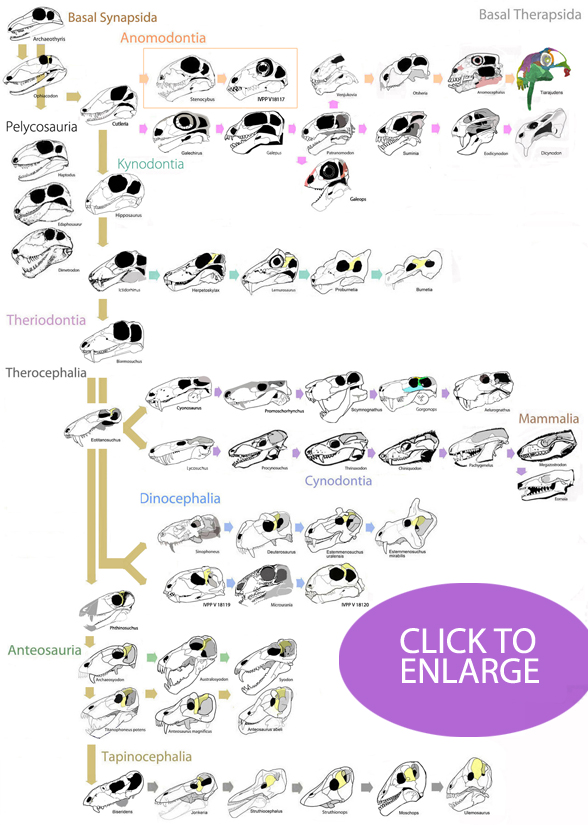
Biarmosuchus tener (Tchudinov 1960) Late Permian ~260 mya was derived from a sister to Hipposaurus and Burnetiadae. Biarmosuchus phylogenetically preceded Eotitanosuchus and the rest of the Therapsida, including mammals and man, sans Anomodontia.
Distinct from Hipposaurus, the skull of Biarmosuchus was elongated with an elongated premaxilla dorsal process (both as in Ophiacodon). Huge canine teeth dominated the jawline, which otherwise had fewer teeth. The premaxilla rose anteriorly exposing procumbent incisors. The pineal opening (third eye) was raised like a little volcano. The anterior dentary developed a strong chin. The reflected lamina became a thin sheet of bone reinforced by a cross of thicker bone.
Distinct from Ophiacodon, the neck was longer and included more vertebrae.
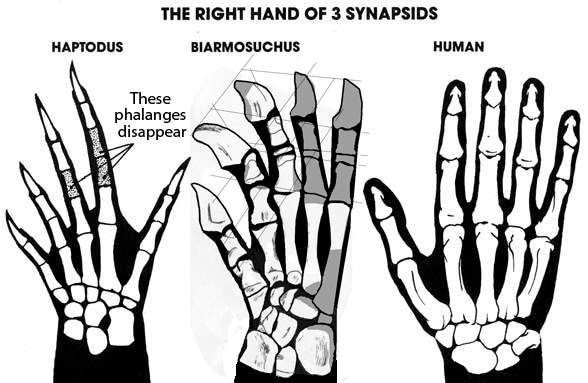
The scapula was less robust and rode more loosely on the ribcage. Metarsal 5 was longer and the lateral fingers and toes were shorter, brought about by the reductions of m3.2, m4.2 and m4.3 (see below). This permitted the hands and feet to swing more directly beneath each limb, rather than out to the sides (as in Gephyrostegus), during the recovery stroke of each stride. This change helped reduce the amount of torso undulation and thus enabled Biarmosuchus to breathe more easily while walking.
The pelvis was relatively much larger. The femur was longer and elevated the torso higher off the ground while walking.
Tetraceratops (Matthew 1908) was considered the most primitive therapsid by Laurin and Reisz (1996), but cladistic analysis indicates it shares more characters with Tseajaia, a limnoscelid, which has never been included in previous cladistic analyses of Tetraceratops. |