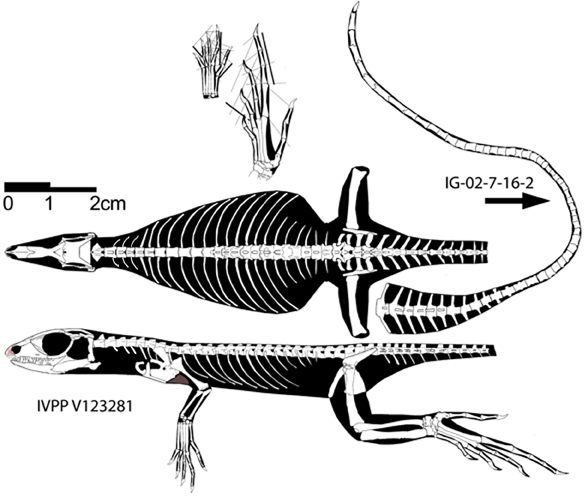
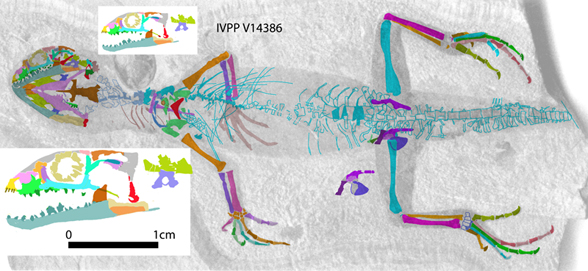
Dalinghosaurus longidigitus (Ji 1998) Early Cretaceous was reported to be related to the modern-day lizards in the family Xenosauridae (Shinisaurus in China), Xenosaurus in Mexico and two extinct lizards, Exostinus and Carusia. One fossil skeleton of Dalinghosaurus includes ten juveniles (Evans and Wang 2005). Despite the disparity in limb length, Evans and Wang (2005) considered Dalinghosaurus a climber, not a biped. The elongated hind foot was equal in length to the rest of the hind limb. In the large reptile tree Dalinghosaurus nested outside the Squamata as a sister to Homoeosaurus.
Distinct from Homoeosaurus, the skull of Dalinghosaurus had a larger orbit and a deeper preorbital bone with a reduced lacrimal. The jugal and postorbital bones were relatively more gracile. The mandible was deeper with a longer, deeper retroarticular process.
The cervicals were longer. The dorsal ribs were much wider producing a flattened cross-section as in Bavarisaurus. The transverse processes of the anterior caudals were longer. The tail was longer and more robust.
The scapulocoracoid was fused and fenestrated anteriorly. The interclavicle is cruciform. The humerus, radius and ulna were more gracile. The metacarpals were longer.
The pubis was longer and the ischium was more robust. The feet were much longer and longer than the femur + tibia. The astragalus and calcaneum were co-ossified. |