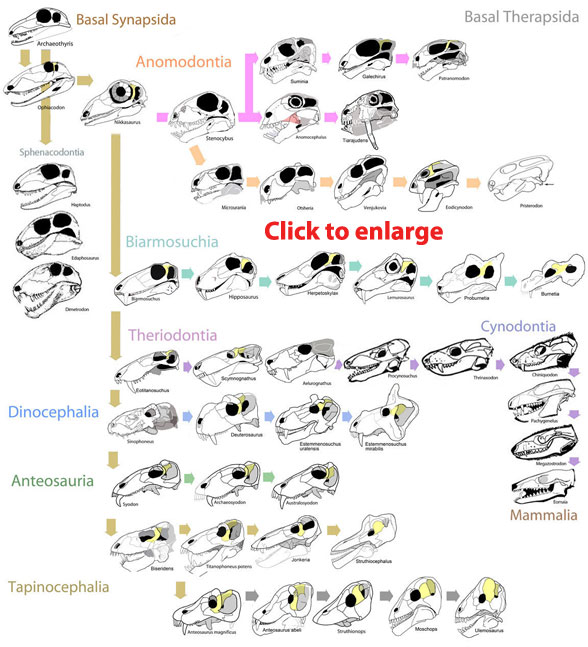
Galechirus scholtzi (Broom 1907) Late Permian ~30 cm in length was a basal therapsid derived from a sister to Biarmosuchus and Titanosuchus.
Smaller and distinct form Biarmosuchus, the skull of Galechirus had a shorter rostrum and much smaller teeth and no canine fang. The orbit was larger. The posterior skull is unknown.
The cervicals were relatively smaller. The neural spines were shorter and more gracile. The specimen was found in a curled up position, demonstrating great flexibility in the spine and tail.
The pectoral girdle was relatively smaller with a scapula that barely reached the base of the vertebral centra. The scapula and coracoid were not fused. The clavicle was more gracile. No disc-like phalanges remained in the manus.
The ilium was anteroventrally shorter. No disc-like phalanges remained in the pes.
Suminina getmanovi (Ivachenko 1994) Late Permian, ~260 mya, 5.5 cm skull length, was a small basal therapsid famous for its "grasping" hands, making one of the first tree-dwelling vertebrates and the first one in the synapsid lineage. Distal carpal 1 was elongated (likely the product of fusion with the medial centrale which is otherwise absent).
Distinct from Galechirus, Suminia had larger teeth, especially anteriorly.
The cervicals were smaller, with lower neural spines. Fewer dorsals were present. The dorsal ribs were longer anteriorly, producing a deeper anterior thorax. The caudal chevrons were reduced to absent on the posterior 2/3 of the tail.
The scapula was taller. The forearm was slightly longer. The fingers were relatively longer. Manual digit 4 included a disc-like phalanx (similar to Biarmosuschus).
The ilium was expanded anteriorly and posteriolry. The femur was more robust. Pedal digit 1 was longer and, like the "thumb" may have been able to provide more a of a grasp by opposing digits 2-5. |