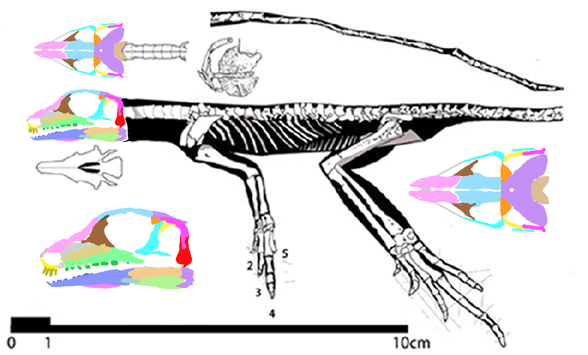
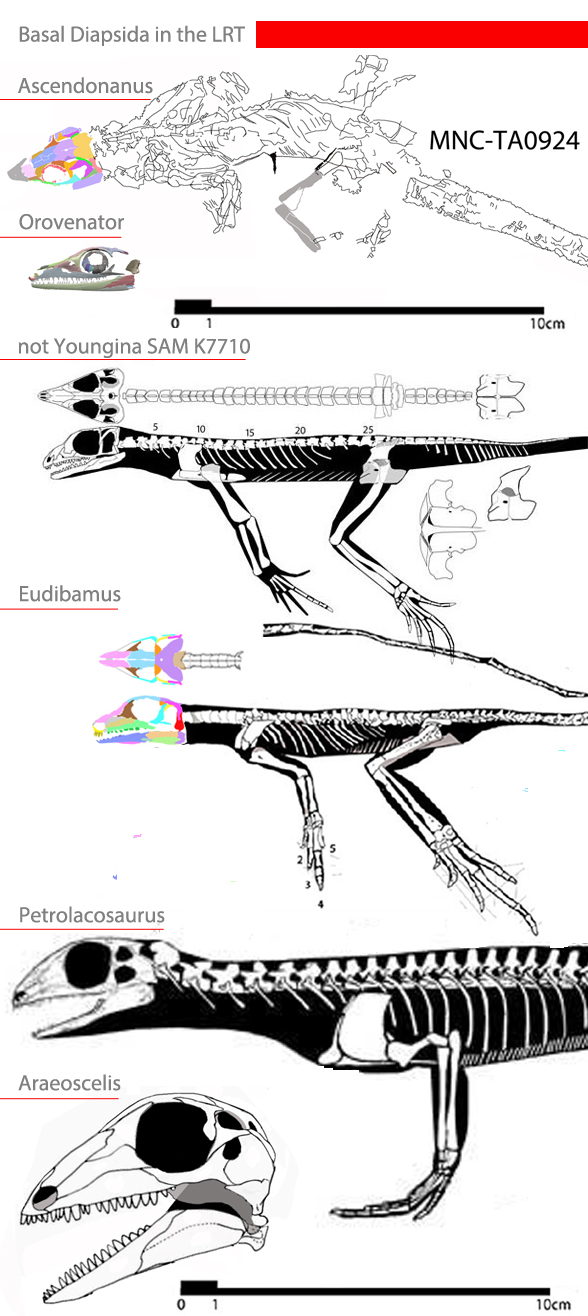
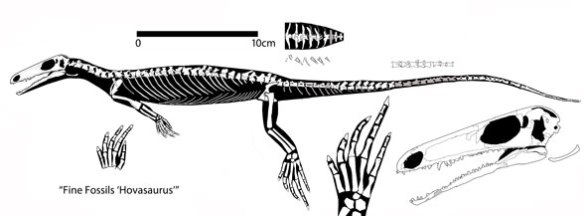
Eudibamus cursoris (Berman et al. 2000) Early Permian ~290 mya, ~25 cm in length, was originally considered a relative of Bolosaurus, but here it nests at the base of the Diapsida, as old as the other basal diapsid, Petrolacosaurus. Derived from a sister to Milleropsis, Eudibamus phylogenetically preceded Petrolacosaurus and Araeoscelis.
Distinct from Milleropsis, the skull of Eudibamus had a much shorter rostrum. The teeth were smaller. The mandible was deeper.
The anterior cervicals were elongated. Dorsal ribs were only present on the first 2/3 of dorsal vertebrae. The last five were more gracile. The anterior caudal transverse processes bent posteriorly. The attenuated tail preserves no chevrons or neural spines. Such an attenutated tail is also found in Triassic bipedal fenestrasaurs, such as Sharovipteryx.
The forelimbs were shorter. The carpals were elongated, as in Petrolacosaurus. The medial digits were greatly reduced.
The hind limbs were robust and much larger than the forelimbs. The tibia+fibula was longer than the femur. Pedal digit I was pariticularly short while digit IV was robust and elongated.
Eudibamus nests close to the base of the Diapsida extending in three directions: 1) toward Petrolacosaurus and the Araeoscelida; 2) toward the marine Enaliosauria; and 3) toward the terrestrial younginiforms.
Eudibamus was originally considered to be the first bipedal vertebrate due to the disparity in the lengths of its limbs. If so, it may have left impressions of only the big fourth toe when running, which was large enough to have acted independently of the others. This would be an autapomorphy for this clade and unusual in a tetrapod experimenting with bipedality. Typically when the limbs begin to swing beneath the knees, as in Biarmosuchus and Sharovipteryx, more toes tend to become more even in their lengths.
The other possibility is that Eudibamus used all of its toes to walk with an extremely wide splay. Gephyrostegus in anterior view provides the reason why the digits were increasingly longer laterally in splay-legged tetrapods. This is taken to the extreme in Eudibamus. Perhaps it clung toforaging between rock cracks instead. |