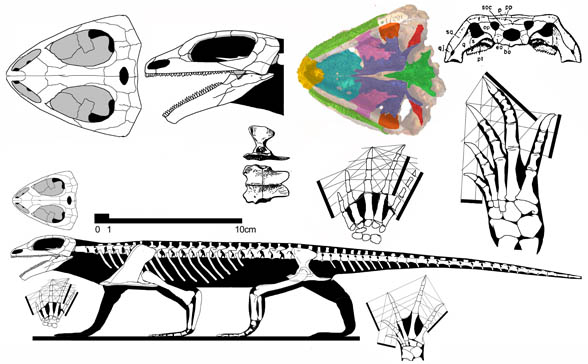
Nyctiphruretus acudens (Efremov, 1938) Late Permian ~253 mya, ~36 cm in length, was considered a parareptile and either a procolophonid or a pareiasaur by Säila (2010) who used a matrix from Tsuji (2006).
Derived from a sister to Macroleter, Nyctiphruretus was basal to Owenetta.
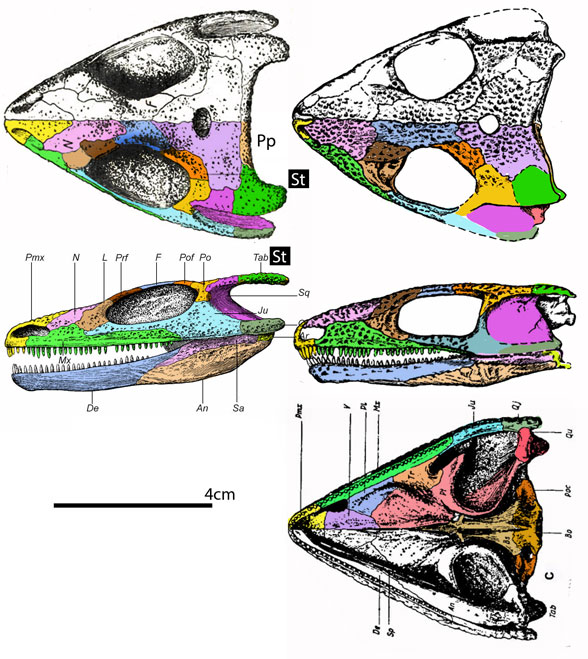
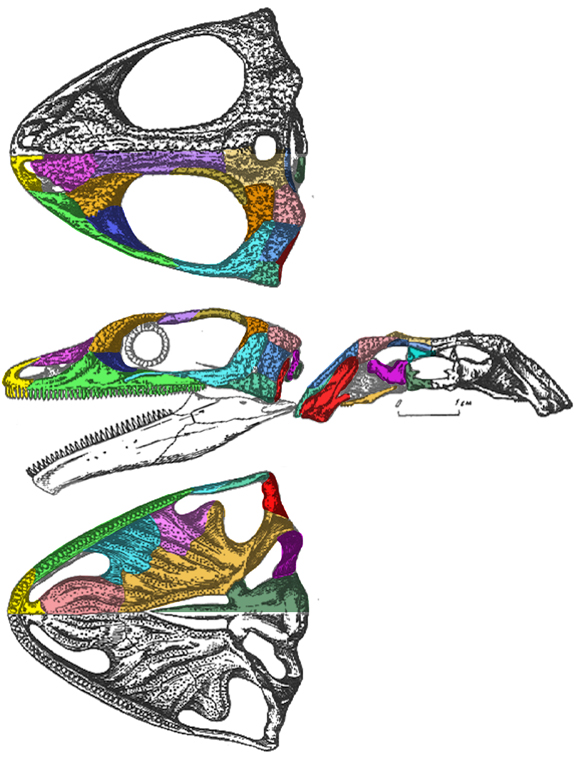
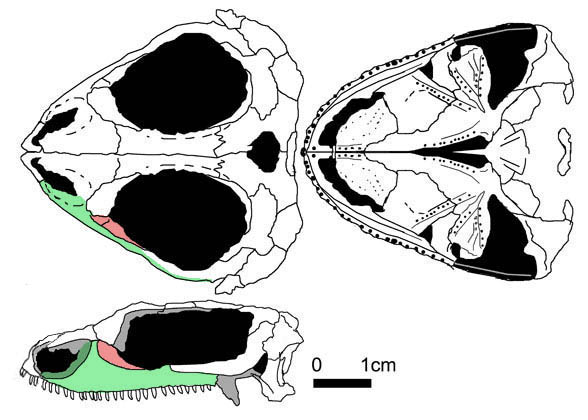
Overall smaller and distinct from Macroleter, the skull of Nyctiphruretus had a shorter rostrum, no temporal "horns" and lost the otic notic. The skull was flatter with a narrower skull roof and orbits that opened more dorsally. One specimen (below) had a ventrally open lateral temporal embayment on a greatly reduced postorbital area. This further develops in the owenettids and lepidosauriforms. The other retained a long contact between the quadratojugal and jugal. The posterior internal nares (choanae) were not curved medially. The pterygoids contacted each other only anteriorly. A suborbital fenestra was present between the palatine and ectopterygoid. The teeth were smaller and uniform.
The ribs were more gracile. The transverse processes of the anterior caudals were not bent posteriorly.
The clavicle was smaller. The scapula and coracoid were fused. The limbs were more gracile. The ilium was taller and larger. The pubis and ischium were medially directed. The glenoid and acetabulum opened at the lowest points on the pectoral and pelvic girdles. The manus and pes elments were much longer and more gracile.
Below: The holotype skull. |