Brusatte SL , Benton MJ , Desojo JB and Langer MC 2010. The higher-level phylogeny of Archosauria (Tetrapoda: Diapsida), Journal of Systematic Palaeontology, 8:1, 3-47.
Parrish MJ 1993. Phylogeny of the Crocodylotarsi, with reference to archosaurian
and crutotarsan monophyly. Journal of Vertebrate Paleontology
13:287–308.
Sues H-D, Nesbitt SJ, Berman DS and Henrici AC 2011. A late-surviving basal theropod dinosaur from the latest Triassic of North America. Proceedings of the Royal Society B, published online
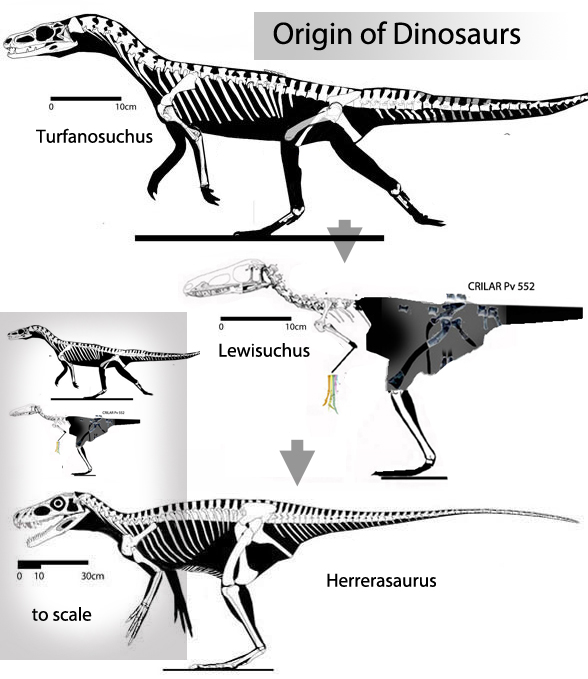
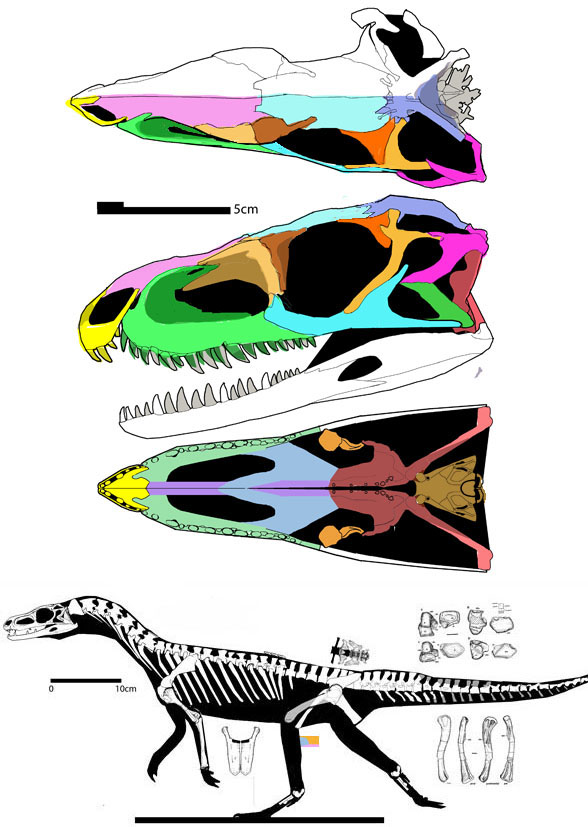
Wu X-C and Russell AP 2001. Redescription of Turfanosuchus dabanenesis (Archosauriformes) and new information on its phylogenetic relationships. Journal of Vertebrate Paleontology 21(1):40-50. Online pdf.
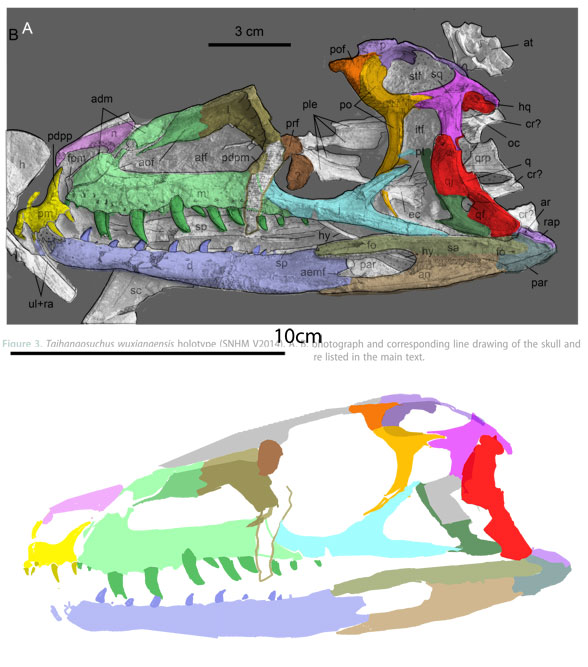
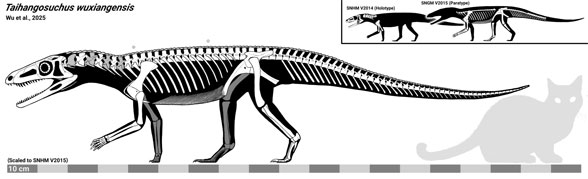
Wu X-C et al 2026. Taihangosuchus wuxiangensis, a new gracilisuchid (Archosauria: Pseudosuchia) from the Middle Triassic of Shanxi Province, China. Historical Biology,
DOI:10.1080/08912963.2025.2537848
Young CC 1973. [On a new pseudosuchian from Turfan, Sinking
(Xinjiang).] Memoirs of the Institute of Vertebrate Paleontology
and Paleoanthropology of the Academia Sinica, Series B 10:15-37.
wiki/Turfanosuchus
wiki/Taihangosuchus |