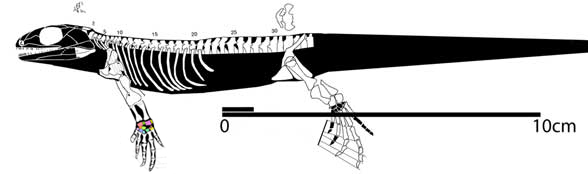
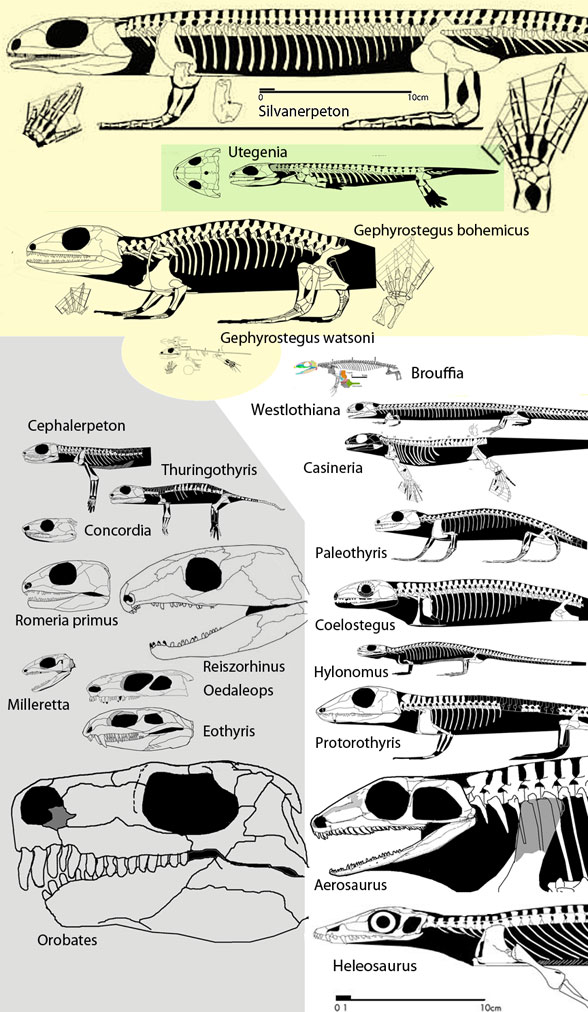
Casineria kiddi (Paton, Smithson & Clack 1999) Visean, Carboniferous, ~335 mya was a small basal archosauromorph. the oldest but not the most primitive. It was derived from a sister to Diplovertebron and Solenodonsaurus. Westlothiana was a sister taxon.
Overall smaller than and distinct from Gephyrostegus, the skull of Casineria had no otic notch. See Brouffia for more possible skull details.
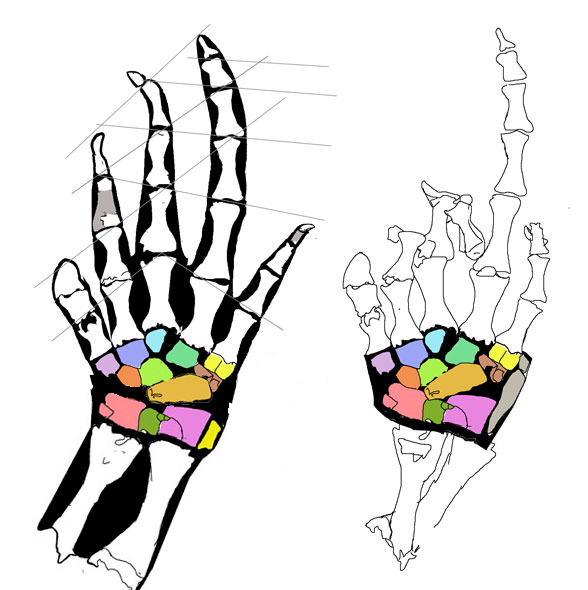
The cervicals of Casineria were increased in number but decreased in size. The presacral vertebral count had increased to over 30. Ribs discontinued after #22. Two vertebrae formed the sacrum and were connected to the pelvis. The pectoral girdle was composed of unfused elements. The humerus had a small hourglass shape. The manus was enlarged. The ilium had no anterior dorsal process. The femur was more gracile. The pes was reduced, more nearly the size of the manus.
Tiny Casineria lies at the end of a phylogenetic series of decreasing size beginning with Proterogyrinus and continuing with Silvanerpeton and Gephyrostegus among the basal Tetrapoda. Smaller animals generally mature faster and thus reproduce more often, although their lifespans are also typically shorter (Carroll 1970).
The first eggs provided with an amniotic membrane were probably small and laid by small adult females who lived and laid eggs in moist leaf litter, a transitional environment that stayed humid and protected both the adult and the egg from desiccation.
A series of sisters to Tulerpeton invented the amniotic membrane, which surrounds and protects the developing embryo in all reptiles (including birds and mammals). The eggs of Cephalerpeton and Cassineria were more or less protected from desiccation and so could be laid away from water, but probably in damp leaf litter and moss rather than any hot and arid place. There is no fossil evidence that an eggshell was created at this node.
The term Amniota is used to encompass all reptiles, birds and mammals. However, in the present tree the inclusion set of taxa within the Amniota is redundant with the Reptilia. Hence the more recent term, Amniota, can now be dropped from usage. |