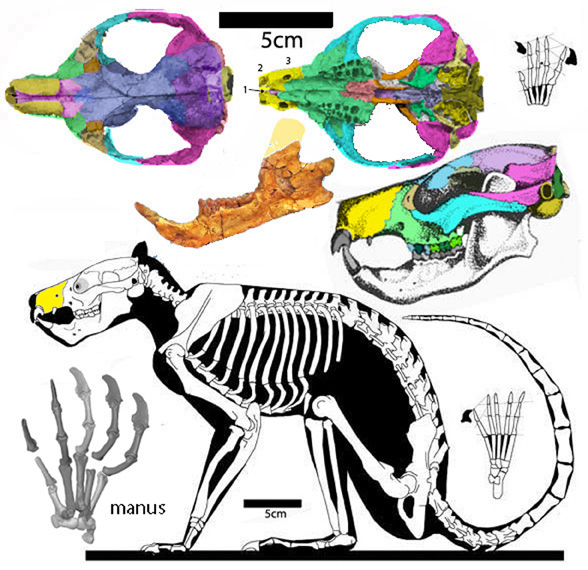
Plesiadapis tricuspidens (Gervais 1877) Paleocene ~55 mya. The Plesiadapiformes were widely thought to be the earliest representatives of the primate order, but here they nest basal to rodents + shrews + multituberculates, derived from Henkelotherium.
Plesiadapis had a deeper shorter rostrum and a higher orbit, but a smaller braincase. The jugal was more robust. The ear was raised. The mandible was more robust with deeper surfaces for muscle attachement and a more robust angular process and a longer coronoid process. The cervicals were shorter. The dorsals, ribs and lumbars were more robust along with the caudals. Chevrons developed at a likely sitting point. The limbs and girdles were more robust. The radius was anteriorly boewed and the ulna developed a large olecranon process (elbow). The unguals were large and deep. The feet were larger than the hands. The joints were nearly all transversely aligned indicating a simple extension/flexion motion for the fingers and toes.
Henkelotherium guimarotae (Krebs 1991; Jäger, Lu and Martin 2019; Late Jurassic 150 mya) was traditionally considered a eupantothere (replaced by Dryolestida). Here Henkelotherium nests with Pleisiadapis. basal to multituberculates, shrews and rodents. The manus was small and the pes had long digits with asymmetric metatarsals. The lumbar region was long and flexible. |