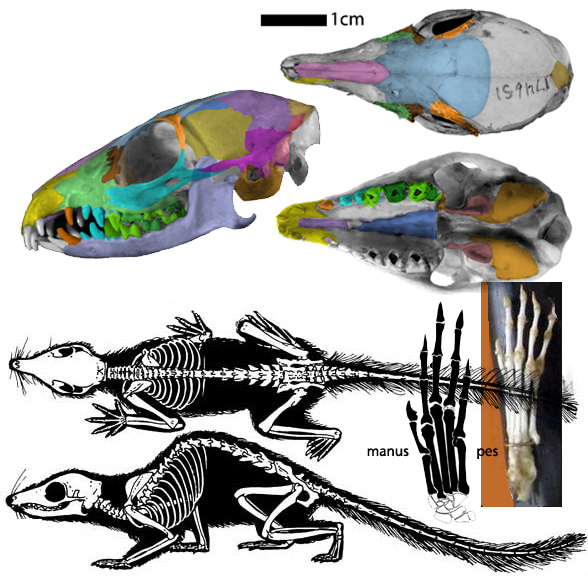
Tupaia chinensis (skull) Tupaia tana (the large tree shrew, Raffles 1821) extant, was derived from a sister to Ptilocercus and was basal to the gnawing clade Glires. Tupaia probably originated deep in the Jurassic, but their fossils go back only 3 million years. The incisors and canines are similar. The dentary incisors extend anteriorly. A pair of feathery extra tongues are found beneath the main tongue. These are also found in lemurs, so this must be primitive trait within Placentalia. Tree shrews are not directly related to primates like Notharctus, as formerly believed.
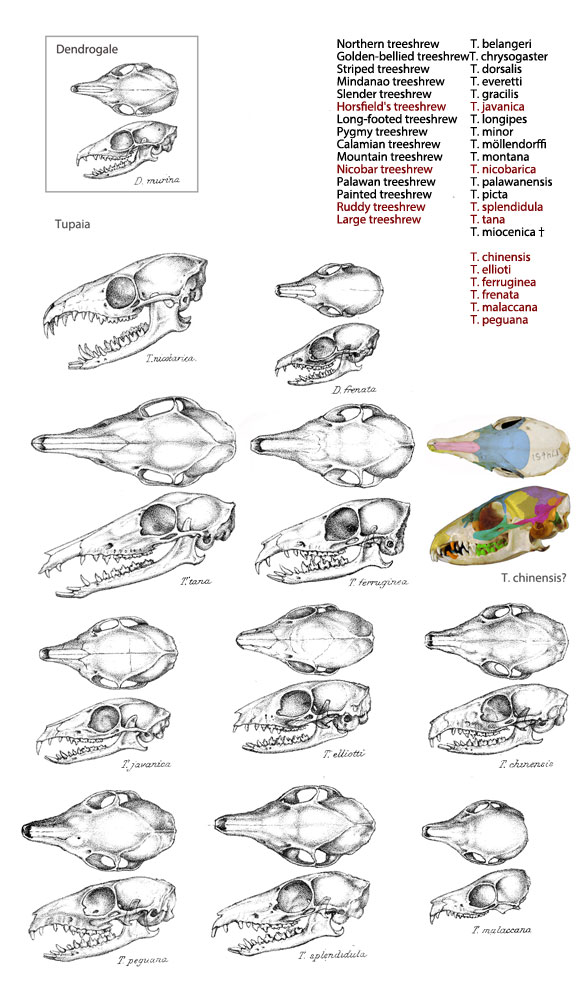
A variety of species is present within this genus.
The tree shrew acts like a squirrel, but instead of eating nuts, tree shrews eats insects. To find prey tree shrews rely on their eyes and their hands. Tree shrews are active during daylight, which sets them apart from more primitive animals. Because of this their internal temperatures are set higher, closer to the 98.6 degrees. To maintain their temperature and their active lifestyle a tree shrew must eat its weight in food each day.
Tree shrews gallop, which is basically a series of leaps in which all four feet are in the air at the same time. That's a new way to locomote relative to transitional marsupials, like Monodelphis.
Tree shrews produce a few sounds, from a snarling hiss to a piercing squeal. They also chatter when alarmed. Most have cartilage that shapes the outer ear. Like a dog, tree shrews can draw back their upper lip to expose their teeth, which is their only facial expression.
Males and females are almost identical. Females give birth to between one and three young after 50-day pregnancy. Babies are born naked with ears and eyes closed. Species that give birth to a single baby have a single pair of breasts. Those that give birth to three at a time have three pairs of breasts. Newborns are nestbound. They receive maternal visits every other day for no more than 10 minutes at a time. After 6 weeks they are weaned. They mature in 4 months. |